TWO:But of far greater historical interest than such criticism is that of Ramsay, the Scotch poet and painter, to whom a copy of Beccaria¡¯s treatise had been shown by Diderot, and who wrote a letter about it to the latter, which, though it contains some very just criticisms on Beccaria, yet reads for the most part very curiously by the light of subsequent history, and illustrates graphically the despair of all reform then felt by most men of reflection.[8]In those days to steal five shillings¡¯ worth of goods from a shop was a capital offence, and Paley had explained the philosophy of the punishment. It would be tedious to follow the course of Romilly¡¯s bill against this law, called the Shoplifting Act,[62] through the details of its history. Suffice it to say that it passed the Commons in 1810, 1811, 1813, 1816, but was regularly thrown out by the Lords, and only definitely became law many years later. But though the debates on the subject no longer possess the vivid interest that once belonged to them, and are best left to the oblivion that enshrouds them, it is instructive to take just one sample of the eloquence and arguments, that once led Lords and Bishops captive and expressed the highest legal wisdom obtainable in England.
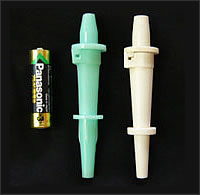
A hydrocyclone (liquid cyclone) injects treatment solution into stationary equipment to perform separation, classification, and concentration, and is an innovative separator with a very simple structure and no drive unit.
Structure of a hydrocyclone (liquid cyclone)
A suspension containing fine particles of several micrometers or more is supplied to a cylindrical container circumferentially at high speed. And as a result it starts to rotate and a centrifugal force is generated. At this time a gravitational acceleration of several tens of thousands of G is generated in the circumferential direction, and thus leading to fast sedimentation and concentration of the fine particles. The separated concentration can be freely selected by changing the supply rate (supply pressure and flow rate) and the flow ratio of the outlet. Our hydrocyclone (liquid cyclone) was designed and manufactured to classify and concentrate fine particles, and so has a small element.
THREE:From this we see how useful is the art of printing, which makes the public, and not a few individuals, the guardians of the sacred laws, and which has scattered that dark spirit of cabal and intrigue, destined to disappear before knowledge and the sciences, which, however apparently despised, are in reality feared by those that follow in their wake. This is the reason that we see in Europe the diminution of those atrocious crimes that afflicted our ancestors and rendered them by turns tyrants or slaves. Whoever knows the history of two or three centuries ago and of our own, can see that from the lap of luxury and effeminacy have sprung the most pleasing of all human virtues, humanity, charity, and the toleration of human errors; he will know what have been the results of that which is so wrongly called ¡®old-fashioned simplicity and honesty.¡¯ Humanity groaning under implacable superstition; the avarice and ambition of a few dyeing with human blood the golden chests and thrones of[132] kings; secret assassinations and public massacres; every noble a tyrant to the people; the ministers of the Gospel truth polluting with blood hands that every day came in contact with the God of mercy¡ªthese are not the works of this enlightened age, which some, however, call corrupt.
- Equipment costs can be reduced.
- Operating costs can be reduced.
- Maintenance costs can be reduced.
- Any change in raw material and product can be easily addressed.
- Large amounts can be treated in a small area.
- Separation and cleaning are easy because of the simple structure.
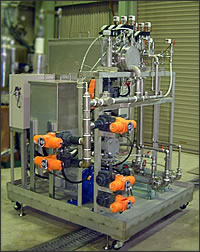
- Simplified control
- This equipment can be operated in synchronization with external devices.
- Alarm and interlock mechanism.
THREE:One thing that might be done, which would also serve at the same time to keep a prisoner¡¯s family from want, the main source of crime, would be the formation of a Prisoners¡¯ Fund, for his and their benefit. For this there is a precedent in a quite recent Act. For the Act, which abolished the forfeiture of a felon¡¯s property, enabled the Crown to appoint an administrator of it, for the benefit of the persons injured by the crime and the felon¡¯s family, the property itself and its income reverting ultimately to the convict or to his representatives. There could, however, be no objection in justice to the forfeiture of a proportionate part of every felon¡¯s property, such forfeiture to be dedicated to the formation of a fund, out of which assistance should be given, both to the families of prisoners during their custody and to the prisoners themselves on their discharge.[62] Such a fund might be still further increased by the substitution of a lien on a man¡¯s wages or income for many minor offences now punished, but not prevented, by imprisonment.When the community is one of individuals, the subordination that prevails in the family prevails by agreement, not by compulsion; and the sons, as soon as their age withdraws them from their state of natural dependence, arising from their feebleness and their need of education and protection, become free members of the domestic commonwealth, subjecting themselves to its head, in order to share in its advantages, as free men do by society at large. In the other condition the sons¡ªthat is, the largest and most useful part of a nation¡ªare placed altogether at the mercy of their fathers; but in this one there is no enjoined connection between them, beyond that sacred and inviolable one of the natural ministration of necessary aid, and that of gratitude for benefits received, which is less often destroyed by the native wickedness of the human heart than by a law-ordained and ill-conceived state of subjection.
- Classification and concentration for the manufacture of inorganic powder materials
- Classification of ceramic materials
- Removal of fine particles, including iron powder
- Removal of fine particles from pigments
- Removal of fine organic particles from solvents
- Separation of starch and yeast
- Removal of fine particles from high-temperature strong acid solutions
- Removal of fine particles from low-temperature solutions